
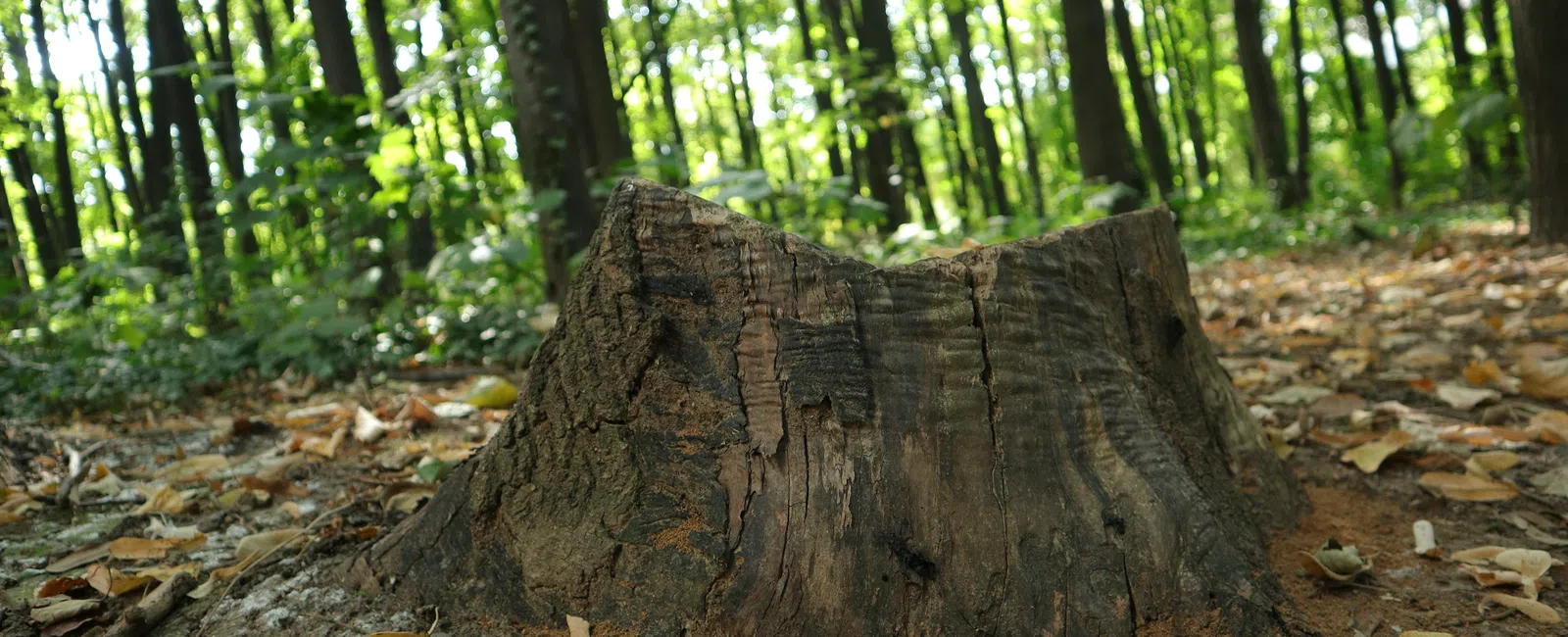
A decaying stump is one of the easiest meals a termite colony will ever find. When that stump sits a few feet from a foundation, the question stops being about how the yard looks and starts being about the house.
Why Termites Move Into Tree Stumps
Termites eat cellulose, and dead wood sitting in damp soil is the ideal source. A stump checks every box: it is already dead, it holds moisture, it is partly decayed, and it stays in direct contact with the ground.
Subterranean termites are the most common type across the eastern United States, and they nest in the soil rather than in the wood itself. They build tunnels out from the nest to reach a food source, then travel back and forth. A stump is essentially a feeding station bolted to the ground, and the root system running underneath it gives the colony a protected path to spread in several directions at once.
That is also why an old stump can host termites for years without anyone noticing. Most of the activity happens below grade or inside the wood, where nothing is visible from the yard.
Signs of Termites in a Tree Stump
Termite activity in a stump is usually easier to spot than activity inside a wall, because the damage is out in the open. Watch for:
- Mud tubes. Pencil-width tunnels made of soil and saliva running up the sides of the stump or across nearby surfaces.
- Hollow, papery wood. Wood that crumbles or gives way when pressed with a screwdriver, often with layered galleries running along the grain.
- Cream-colored insects. Soft-bodied, pale insects inside the wood when a piece is broken open.
- Discarded wings. Small piles of shed wings near the stump in spring after a swarm.
- Soil packed into the galleries. Subterranean termites bring dirt with them, so their tunnels look muddy rather than clean.
Carpenter ants are the most common thing mistaken for termites in a stump. Ants have hard, dark bodies with pinched waists, and they push wood shavings out of their galleries, leaving a small pile that looks like sawdust. Termites are pale and straight-sided, and they leave the galleries packed rather than clean. Either way, the stump is doing the same thing: giving a colony a reason to live near the house.
Termites in a Tree Stump Near the House
Distance is the part that matters most. Subterranean termite colonies forage well beyond their nest, sometimes more than 100 feet, so a stump does not have to be touching the foundation to be a problem. What it does is give a colony a reason to establish and grow in the immediate area, and once a colony is established it keeps exploring outward.
A few conditions raise the risk:
- The stump sits within roughly 20 to 30 feet of the foundation, a crawl space, or a deck footing.
- The soil around the stump stays damp, whether from shade, downspouts, or low spots that hold water.
- Wood siding, deck posts, or framing come close to grade nearby, giving the colony an easy next stop.
None of that guarantees termites will get into the house. It does mean the stump is working against you, and removing it takes one strong attractant out of the equation.
Does Stump Grinding Get Rid of Termites?
Stump grinding removes the food source, not the colony.
This is worth being clear about, because the two often get confused. A stump grinder reduces the stump to chips below grade and takes away the shelter and the meal. It does not treat the soil, and it does not kill a subterranean colony that is already nesting nearby. Insects in the ground stay in the ground.
The order that usually makes sense is to have an active infestation inspected and treated by a licensed pest control company first, then have the stump ground out so there is nothing left to draw the colony back to that spot. Treatment handles what is already there. Grinding handles the reason it showed up.
Grinding also leaves the root system in place to break down naturally over time. Those roots are still wood, but they are smaller, deeper, and scattered, which is a very different target than a large stump sitting at grade with moisture collecting around it.
What to Do With the Wood Chips
Stump grinding produces a pile of wood chips, and homeowners often spread them as mulch. That works fine in most situations, but it is worth thinking twice about when termites were part of the reason the stump came out.
Fresh grindings are still cellulose, and a thick layer of them banked against a foundation or a deck post keeps moisture right where it does the most harm. If the stump was infested, or if it sat close to the house, hauling the material off the property is the cleaner outcome. Spreading it in a garden bed well away from the structure is a reasonable middle ground.
Other Pests That Take Up Residence
Termites get the attention, but they are not the only thing that moves into a decaying stump. Carpenter ants hollow out damp wood to nest in it, wood-boring beetles work through the dead heartwood, and open cavities in a rotting stump make convenient shelter for yellow jackets and small animals.
The common factor is decay. A stump that is breaking down is a habitat, and it stays a habitat for as long as it is there. That is one reason removing a stump tends to solve several problems at once rather than just one.
Get the Stump Out of the Equation
If there is a stump near your house that is starting to soften, hollow out, or show mud tubes, taking it out removes a standing invitation to whatever is living in it.
SWVA Stump Co grinds stumps below grade for homeowners across Southwest Virginia, Northeast Tennessee, and Western North Carolina, and can haul the grindings completely off your property when you would rather not leave the material behind. We also handle small tree removal if a dead or declining tree is still standing over the stump you want gone.
Call (276) 597-1221 for a free, no-obligation estimate.