
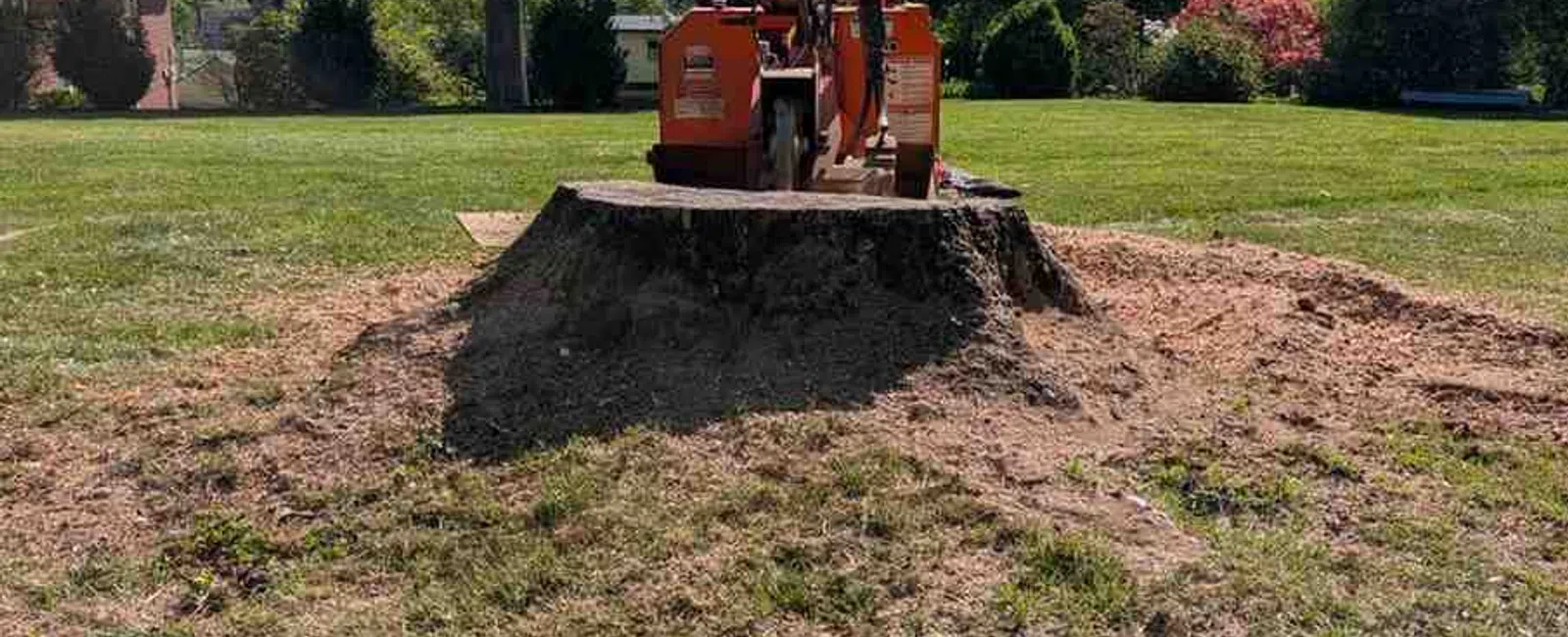
Stump grinding reduces a stump to wood chips several inches below ground level, which is enough to cover the spot with topsoil and grow grass over it. Most single stumps take under an hour. How deep the wheel actually gets on a given job depends on the soil, the species, and what is going into that ground afterward.
What Below Grade Means In Practice
Below grade means the cut face of the stump ends up under the surrounding soil line rather than level with it. Once the grindings and topsoil go back over the hole, nothing shows, and a mower never touches what remains.
That depth is set to the job rather than to a fixed number. A stump being covered with grass needs less than one being cleared for a planting bed, and an operator reads the site before deciding where to stop.
Species changes the work more than most people expect. Oak and hickory are dense and grind slowly. Poplar and pine come apart faster, so the same size stump in pine takes noticeably less time than one in oak.
Depth Depends On What Goes In That Spot
| What the spot is used for | What the grind needs to reach | Why |
|---|---|---|
| Grass or new sod | Below grade, covered with topsoil | Turf roots need soil above the remaining wood, and mower blades stay clear |
| A planting bed or shrubs | Deeper, with grindings cleared out | Shallow-rooted plants need soil rather than decaying chips |
| A new tree in the same hole | Deeper than a standard grind | Wood breaking down underground competes with young roots |
| A clean slate for other plans | Full stump removal instead | Removal takes the stump out rather than reducing it |
The mulch matters as much as the depth for planting. Standard stump grinding leaves the grindings piled or raked around the site, which suits a lawn repair. For a bed going in over that spot, the wood chips hauled away leaves cleaner soil to work with.
Planting a new tree in the exact hole is the request that most often calls for something other than a standard grind. Ground wood ties up nitrogen as it decomposes, which is hard on a young tree. Shifting the new tree a few feet to one side is usually simpler than trying to make the original hole work.
What Stops A Grinder Short
Several factors can limit how deep a stump grinder can safely go. The conditions around the stump are just as important as the machine's capabilities.
- Rock can limit grinding depth. Shallow bedrock and buried stone are common throughout Southwest Virginia, particularly on mountainous properties. If the grinder encounters rock beneath the stump, it may not be possible to safely reach the intended depth.
- Buried utilities can restrict how deep you can grind. Because stump grinders can reach below ground level, underground utility lines must be located and considered before grinding begins.
- Septic and irrigation systems can also be in the way. Septic lines, drain field piping, and irrigation lines may run through the area surrounding a stump and can limit how deep or where grinding can safely take place.
- Access can determine what equipment can be used. A stump located behind a narrow gate or in another tight space may require a smaller grinder than a stump in an open yard or field. The size of the equipment can affect the depth and efficiency of the job.
- Larger stumps require more grinding. A wide stump must be ground across its entire surface to achieve a consistent depth, which requires additional passes and more time.
The Roots Stay Either Way
No grinding depth removes the root system. The remaining tree roots run outward from where the stump stood, often past where the branches used to reach, and they break down underground over several years.
Grinding deeper only removes more of the central mass where the trunk meets the ground. For a lawn that rarely matters, since surface roots settle as they decay and topsoil covers the difference.
Schedule Stump Grinding
SWVA Stump Co grinds stumps below grade across Southwest Virginia, Northeast Tennessee, and Western North Carolina, so the spot can be reseeded, landscaped, or built over. Call (276) 597-1221 or request an estimate to get on the schedule.